What is the Process of Secretion of Milk?
When the baby suckles at the breast, sensory impulses go from the nipple to the brain. In response, the brain of the mother produces the hormone prolactin, which travels through the blood to the breast and stimulates the milk-secreting cells to produce milk. This process is called the Prolactin Reflex.
Prolactin remains in the blood for about 30 minutes even after the baby finishes feeding. This helps the breast prepare and secrete milk for the next feed.
- More prolactin is secreted during the night.
- Night breastfeeding helps maintain an adequate milk supply.
- Prolactin suppresses ovulation.
- Breastfeeding can therefore help in birth spacing.
Process of Ejection of Milk (Oxytocin Reflex)
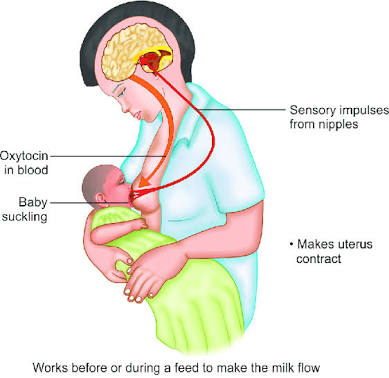
When the baby sucks the breast, messages travel from the nipple to the brain. In response, the brain releases the hormone oxytocin. This hormone travels through the blood to the breast and causes the muscle cells around the alveoli to contract.
These contractions push the milk through the ducts toward the nipple, allowing the baby to receive milk easily. Sometimes milk may even be ejected in fine streams. This process is known as the Oxytocin Reflex or the Milk Ejection Reflex.
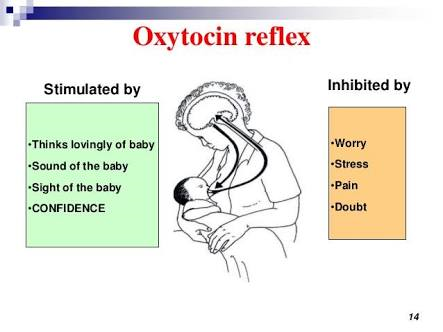
This reflex is strongly influenced by the mother's emotions. Even thinking lovingly about the baby, touching, smelling, seeing the baby, or hearing the baby cry can trigger the oxytocin reflex.
However, if the mother is emotionally disturbed or experiencing pain, discomfort, stress, or doubt, the oxytocin reflex may not work effectively. As a result, the baby may have difficulty getting milk. Therefore, the mother should be supported and made physically and emotionally comfortable so that the oxytocin reflex can work properly and milk can flow easily.